











Highly Recommended
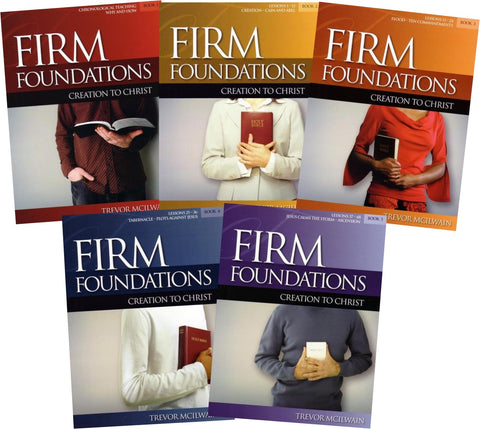
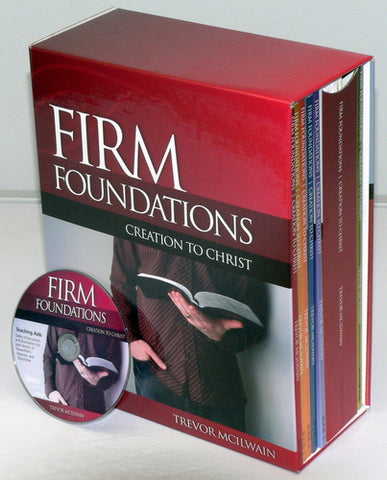
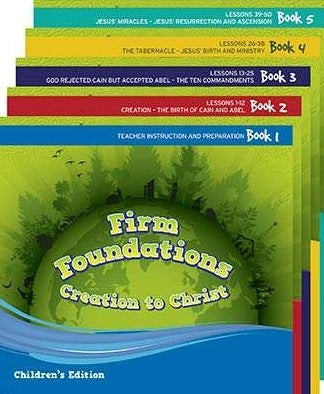
For the past year I have been using Firm Foundations: Creation to Christ at New Morning Church (newmorningchurch.com). I’ll teach the final lesson in just a couple of weeks and I plan on beginning the 48-lesson series again starting in January. While its merits are numerous, I highly recommend it you and your church based on following three.
First, this curriculum confronts error by emphasizing biblical truth. This is huge for me, especially given the context in which I minister. While there may be times when it’s necessary to name names, as pastors we have to be careful not to alienate those in our audience from the truth they need. I have often said that if someone gets upset because of my preaching or teaching, I want it to be because of the biblical truth they were confronted with and not because of the manner in which I presented it. This series allows me to do just that. In matter of weeks it covers the fact that the Bible is inerrant, that God is a Spirit, that matter is not eternal, and that because of Adam each of us are born with a sin nature. As the lessons progress, the Trinity, salvation by faith alone, the deity of Jesus, and the reality of Heaven and Hell are discussed at length. Each of these doctrines are rejected by the majority of Provo’s population. Yet it has been amazing to watch people think through them as they’re introduced from a solely biblical perspective.
Second, this curriculum stresses the unity of the entire Bible. The error mentioned above could be avoided by understanding that the Bible must be taken as a collective whole. In fact, my mantra over the past year has been context, context, context. That’s why I love what the author says in the introductory material:
The majority of Christian teaching emphasizes individual doctrines of the Bible rather than presenting the Bible as one complete, interdependent revelation of God. Heresies, misinterpretation, overemphasis of certain Scriptures, and denominationalism can, in most cases, be traced to this lack of chronological and panoramic Bible teaching.
As you teach chronologically through the Bible, allowing the biblical narrative and major themes to unfold naturally, your audience will see that unity for themselves.
Third, this curriculum encourages interaction. While this is important for developing community within your church, it also helps you gauge comprehension. I want to make sure people understand the significance of the Bible in their own lives. For that purpose each lesson begins with four or five review questions from the previous week. I am all about review, even taking time to recap the previous week’s sermon before preaching, and I enjoy being able to point back to something that has already been preached or taught. Furthermore, each lesson uses numerous Bible passages. Participants are encouraged to read them out loud for the group, seldom more than a couple verses at a time. Additional questions are asked throughout each lesson and are meant to be discussed as a group based on the verses that have been read. Such interaction around the Bible is invaluable for a church at any stage.
If you have never checked out this particular resource, again, I highly suggest that you do. I’ve not been disappointed; I know you won’t be either.